

Lesson 9: AI as Draft Engine
Using AI without creating slop. How to get useful drafts that actually save time instead of creating more editing work.

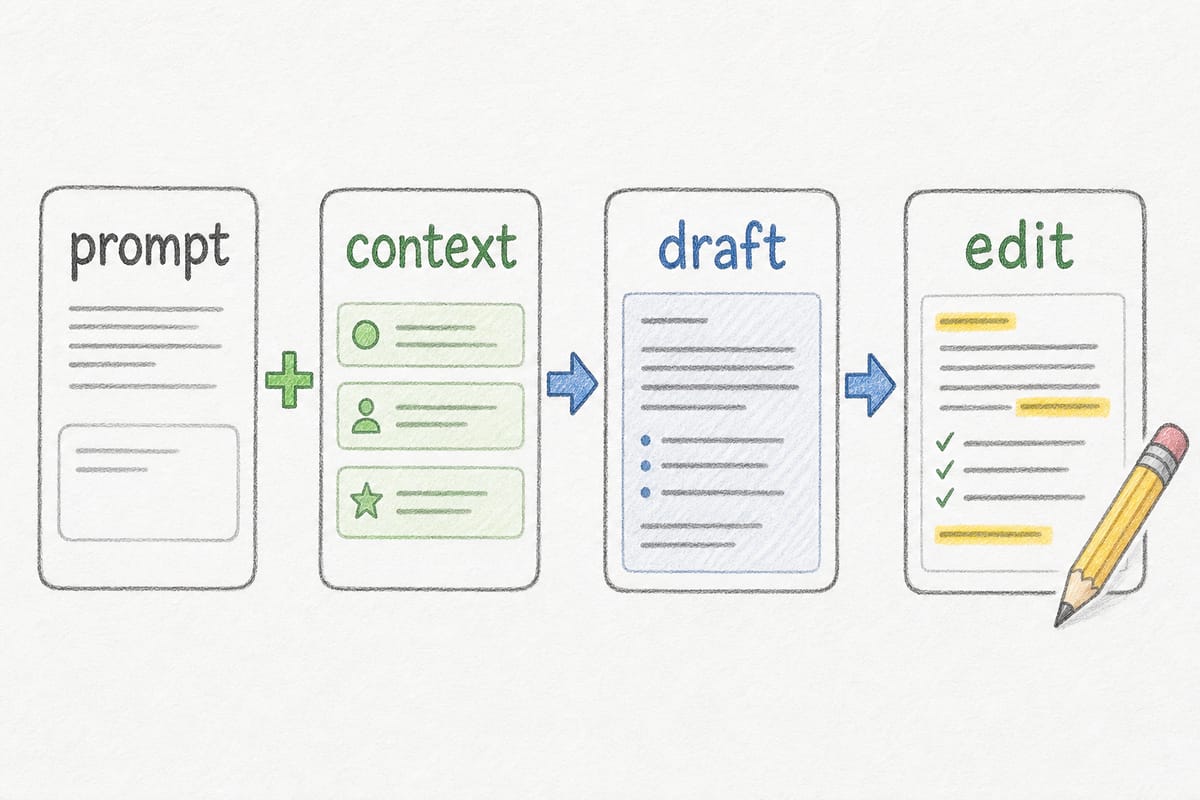
AI doesn't write your content. You do. AI generates drafts you turn into something worth publishing.
If you expect AI to produce finished content, you'll be disappointed. If you expect it to produce raw material you then shape, you'll save hours.
What AI Is Good At
AI excels at getting words on the page. It beats blank-page paralysis. It generates structure when you don't know where to start. It produces paragraphs you can react to, edit, disagree with, improve.
It's thorough. Tell it to cover a topic and it won't forget major sections. It draws on vast training data to include points you might overlook.
It's fast. A rough outline becomes a rough draft in minutes, work that used to take hours or days. Even when the draft needs heavy editing, you're editing something instead of staring at nothing.
It gives you options. Ask for five headlines and you get five headlines. Ask for three angles on an intro and you get three to choose between. That unsticks you when you're trapped in one way of thinking.
What AI Is Bad At
AI doesn't have opinions. It has weighted averages of other people's opinions, so it can sound confident while saying nothing distinctive. That's why AI content reads as bland: it's optimized to be generally acceptable rather than specifically useful. Lesson 4 covers this in detail.
It has no experience. It can describe what using a product or solving a problem is like, but it's making that up. Readers sense the hollowness even when they can't name it.
It doesn't know your audience: your customers' specific frustrations, your industry's quirks, your company's perspective. It generalizes exactly where you need to be specific.
And it doesn't check its work. It sounds authoritative regardless of accuracy, presenting invented facts with the same confidence as real ones. Nothing it gives you is usable without verification.
Context Is Everything
Most bad AI output comes from missing context. "Write a blog post about content marketing" produces generic slop because the AI has nothing to work with. No constraints, no direction. So it produces the average of everything ever written about content marketing.
Better context produces better output. Not elaborate prompts. Just specifics.
Do your research first. Before touching AI, know your keyword, the intent, your angle, and your key points. Ten minutes of prep saves hours of editing garbage.
Work section by section. Don't ask for the whole post at once. Generate one section at a time, edit while context is fresh, then move on. More control, better output.
Give it examples. "Here's a paragraph from a previous post. Write the next section in a similar style." AI is good at pattern matching when you give it patterns.
Tell it what to avoid. "Don't use phrases like 'in today's fast-paced world.'" Explicit constraints reduce generic phrasing.
Feed it your specifics. "We have a customer who reduced content production time by 60%. Incorporate that." AI can weave in real information. That's how you get content that doesn't sound like everyone else's.
Ask for options. "Give me three versions of this intro." You'll often find one that's 80% right, easier to edit than starting from scratch.
The more context you give, the more useful the output. Constraints are what give the model something to aim at.
How CopyJump Handles This
The hard part is getting the right context to the model at the right moment, which you won't manage by pasting a prompt into ChatGPT.
CopyJump runs multi-step workflows that mirror how real copywriters work: research, outline, then draft section by section. Each step builds on the last. The Content Agent pulls from your brand profile and voice guidelines, so drafts already sound like you, not like generic AI output.
It's still generating drafts, not final content. The value is the time saved getting to something you can edit. Instead of writing 2,000 words from scratch, you're editing 2,000 words that are already on-brand. Different work, often faster, but still your work.
The next lesson covers the editing process: the 5-pass framework that turns drafts into content that ranks.
Next: Lesson 10: The 5-Pass Editing Framework
Back to: Course Overview
Want this handled for you? The CopyJump SEO Agent applies these lessons automatically — research, briefs, internal links, and brand-aware drafts.
Meet the SEO Agent