

Lesson 4: Why Most AI Content Doesn't Rank
What separates AI content that ranks from AI content that disappears, and why the fix is process rather than a better model.

AI-generated content can rank. We've seen it work. Google's algorithm evaluates content quality, not content origin, and its guidance on AI-generated content focuses on whether content is helpful rather than on how it was produced.
Most AI content still doesn't rank. Not because Google detects and penalizes AI, but because most AI content is worse than the human-written pages it competes against. That's a usage problem, not a tool problem, which means it's one you can fix.
The Generic Content Trap
Ask ChatGPT to write about almost any topic and you'll get a competent, well-structured, utterly forgettable response. It covers the basics. It uses appropriate headers. It has a reasonable word count. And it sounds exactly like every other AI-generated post on the same topic.
This is the generic content trap. AI is trained on vast amounts of existing content, so it produces a kind of weighted average of everything that's been written. It's good at being typical. It's bad at being distinctive.
When you publish content that's indistinguishable from what already exists, you're asking Google a question it doesn't want to answer: why should this rank instead of the content already ranking? If you don't have an answer, neither does Google.
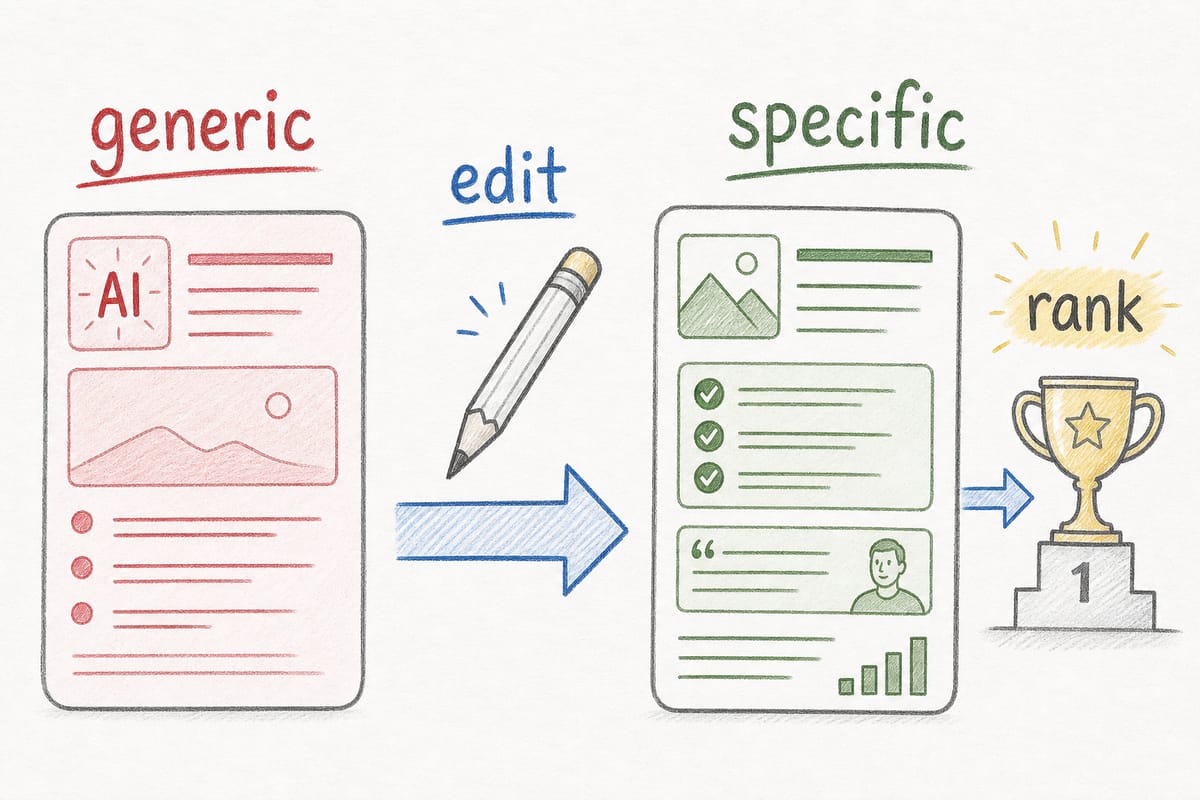
Generic content is the default output of AI. Breaking out of generic requires deliberate effort, which is exactly what the 5-Pass Editing Framework teaches you to do systematically.
The Specificity Gap
Human experts talk in specifics. "When we implemented this for Client X, the specific challenge was Y, and here's how we approached it." AI talks in generalities. "Many businesses face this challenge, and there are several approaches to consider."
This specificity gap is what makes AI content feel hollow. It technically covers the topic but doesn't add anything. There's no moment where the reader thinks "I hadn't considered that" or "that's exactly the situation I'm in."
Better prompts won't close it. What closes it is the thing AI can't generate: your specific experience, your particular perspective, your concrete examples. AI builds the framework. You fill it with substance.
The Intent Mismatch Problem
AI doesn't understand search intent. It doesn't know what someone searching a particular query actually wants. It just produces content that seems topically relevant.
This causes constant intent mismatches. Someone searches "best CRM for small business" and they want a comparison with recommendations. AI produces an essay about why CRMs are valuable. Someone searches "how to fix merge conflict in git" and they want step-by-step instructions they can follow right now. AI produces an overview of version control concepts.
Intent mismatch kills rankings faster than any quality issue. Content that doesn't satisfy the search intent gets bounced back to the results page. Google sees that pattern and demotes the content.
Fixing intent mismatch requires research AI won't do: look at what's actually ranking, understand what format and depth searchers expect, then create content that matches. Lesson 6 covers exactly how to do this research.
The Missing Point of View
Strong content has a point of view. "Here's what I think, and here's why." "This approach is better than that approach because." "Most advice on this topic is wrong. Here's what actually works."
AI doesn't have opinions. It has averages. Ask it a controversial question and it'll present all sides fairly, which sounds helpful but produces useless content. The reader doesn't learn what to think or why. They get a Wikipedia summary when they wanted a trusted advisor.
Having a point of view is a competitive advantage now. When all the AI-generated content sounds the same, the content that takes a stance stands out. This requires something AI can't provide: the confidence to commit to a position based on your experience and expertise.
The Unedited Draft Problem
The most common failure is also the dullest. People publish first drafts.
AI produces a draft. It's pretty good. Certainly better than staring at a blank page. So they hit publish, maybe with a few tweaks to fix obvious errors. Then they wonder why it doesn't rank.
An AI first draft needs everything a human first draft needs, and usually more. The structure needs tightening. Generic sections need specific examples. The voice needs adjusting. The intro needs to earn attention. Links need adding.
Publishing unedited AI content is like publishing your first brain dump. Sometimes you get lucky. Usually you don't.
What AI Content That Ranks Looks Like
AI content that ranks matches intent from the first line. It opens with what the searcher came for and delivers it. No meandering intro, no scene-setting. It starts at the destination.
The examples in it are real. Concrete situations, actual numbers where numbers exist. These prove experience and make the content useful rather than theoretical.
It commits to a position. The author thinks something about the topic and says it, so the piece reads as an argument or a recommendation instead of a balanced overview.
Someone edited it. The structure is clean, the voice is consistent, the generic AI phrasing is gone. It reads like a human wrote it because a human reworked it. Rewriting tools smooth the surface; the real work happens in the editing passes.
And it belongs to something. It links to related content on the same site. It's part of a topic cluster. It shows the site has depth in this area rather than one post chasing a keyword.
The Bottom Line
AI is a draft engine. It gets you from blank page to rough draft faster than typing, and that's the whole of its contribution. The product is what you make out of that draft with your knowledge, your examples, your perspective, and your editing.
Skip the refinement and you get content that looks like content but acts like noise. Google has gotten very good at identifying noise. The August 2025 spam update specifically targeted "AI-washed" content and thin programmatic SEO, devaluing thousands of sites that were pumping out repetitive, low-value pages.
The remaining lessons in this course teach you how to refine. Lesson 9 covers using AI effectively, and Lesson 10 gives you the editing framework. But first, we need to build the foundation: what keywords to target and what strategy to follow.
Next: Lesson 5: Keyword Research That Still Works
Back to: Course Overview
Want this handled for you? The CopyJump SEO Agent applies these lessons automatically — research, briefs, internal links, and brand-aware drafts.
Meet the SEO Agent