

Lesson 2: What Google Actually Rewards Now
E-E-A-T, helpful content updates, and the signals that matter. Why generic fails and what "quality" actually means in 2026.

The content flood from the previous lesson forced Google's hand. Their updates follow a familiar rhythm: they announce something, SEOs panic, the dust settles, and we work out what changed. For two years running, the answer has been the same. Reward content that demonstrates real expertise, demote content that exists to rank. The August 2024 core update made this explicit, stating its goal was to "better surface content that people find genuinely useful" while reducing "content that feels like it was made for search engines."
E-E-A-T: What It Actually Means
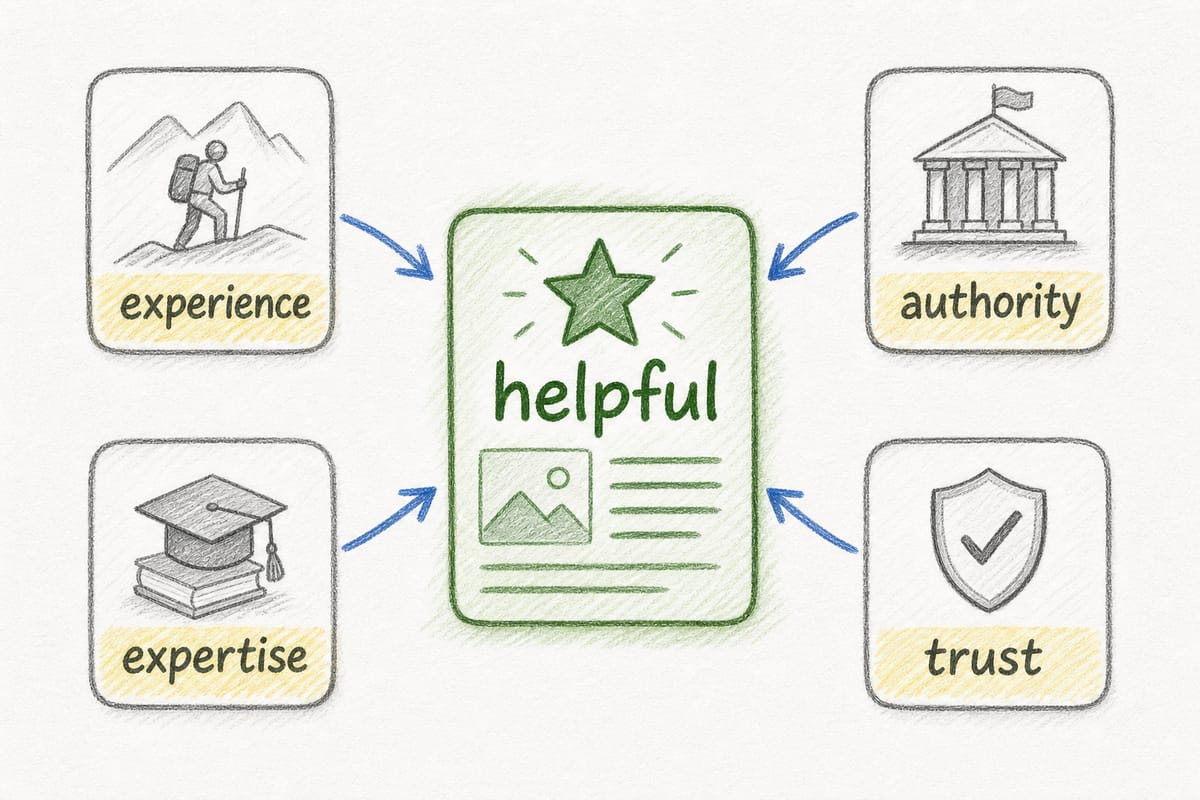
E-E-A-T stands for Experience, Expertise, Authoritativeness, and Trustworthiness. Google added the extra "E" for Experience in late 2022.
Experience means first-hand knowledge. Did you actually do the thing you're writing about? If you're reviewing a product, did you use it? If you're explaining a process, did you follow it? Google is looking for signals that you have direct experience with your topic, not just researched it.
Expertise means you know what you're talking about at a deep level. This doesn't require formal credentials for most topics. It means demonstrating real knowledge through the depth and accuracy of your content. Do you understand the nuances? Can you anticipate questions a reader would have?
Authoritativeness means other sources recognize your expertise. This shows up in backlinks, mentions, citations. It's the "do other people in this space take you seriously?" signal.
Trustworthiness is the foundation. Is your content accurate? Is your site secure? Do you have clear contact information and transparent business practices? Are you honest about your limitations?
E-E-A-T is a framework for understanding what Google's algorithm tries to reward. Google doesn't calculate it as a score. You can't optimize for E-E-A-T like you optimize for keywords. You build it by being experienced, expert, authoritative, and trustworthy, then making sure your content shows it. The December 2025 core update doubled down on E-E-A-T, specifically rewarding sites with long-term brand authority and human-verified information.
The March 2026 core update pushed that same pattern harder. The winners were first-party sources, authoritative brands, and pages with original data or direct experience. The losers were mostly middleman pages that summarized, repackaged, or aggregated information someone else owned. In practice, E-E-A-T in 2026 means being the source rather than another page describing one.
The Helpful Content Updates
Google's helpful content system, rolled out in 2022 and updated several times since, gets described as an AI-content detector. It doesn't scan your text for AI patterns. It evaluates whether your content exists primarily to help readers or primarily to rank in search results. Content that reads like it was written to satisfy an algorithm gets classified as unhelpful, however it was produced.
Google publishes the questions it wants you to ask about your own content:
Does the content provide original information, reporting, research, or analysis? Does it provide a complete description of the topic? Does it offer insight beyond the obvious? If you're drawing on other sources, do you add value beyond just summarizing them? Does the content leave the reader feeling they've learned enough to achieve their goal?
Every one of them asks whether your content has a reason to exist beyond "this keyword gets search volume."
What "Quality" Actually Means Now
Quality used to mean "well-written, properly formatted, reasonably comprehensive." That's the minimum now. Everyone's content is well-written and properly formatted because AI handles that automatically.
Quality in 2026 means:
Specificity over generality. Generic advice is worthless. "Create valuable content" is not advice. "Interview three customers about their biggest frustration with [problem], then structure your post around answering those specific frustrations" is advice. The more specific your content, the more valuable it is. This is why most AI content fails: it defaults to generic.
Perspective over neutrality. "There are many approaches to this problem" is not helpful. "Here's the approach I use and why I think it's better than the alternatives" is helpful. Having opinions signals expertise. Being diplomatically vague signals you don't actually know.
Real examples over theoretical ones. Case studies. Screenshots. Actual numbers. Specific situations you've encountered. This is the experience signal. You can't fake having done the thing.
Honest limitations over overselling. "This works great for X but not for Y" builds trust. "This works for everything" sounds like marketing, and readers (and Google) are skeptical of marketing.
How Google Detects Quality
Google doesn't read your content the way a human does. It infers quality from signals.
User behavior signals. How long do people stay on your page? Do they click through to other pages on your site? Do they return to Google and click a different result? If your content satisfies searchers, they don't need to keep searching. The March 2025 core update specifically refined how Google uses engagement signals and intent clustering, rewarding sites that answer complex queries rather than just surface-level facts.
Content signals. Does your content cover the topic thoroughly? Does it include related concepts that someone with real expertise would naturally mention? Is it structured in a way that matches what searchers are looking for?
Site signals. Is this content consistent with what the rest of your site is about? Do you have other content that supports your authority on this topic? Is your site technically healthy? After the March 2026 update, this matters even more: isolated posts are weaker than a body of content that proves the site owns the topic.
External signals. Do other sites link to your content? Do authoritative sources in your space reference you? Are you mentioned in discussions about your topic?
You don't need to chase any single signal. Write content that helps your readers and the signals follow.
The Practical Takeaway
Stop asking "how do I optimize my content for Google?" Start asking "how do I make my content the best answer to this question?"
That's vague on its own, so here's the concrete test. When you finish writing a piece of content, ask yourself:
If I were searching for this topic and landed on this page, would I feel like I got what I needed? Would I trust this author? Would I remember this content or forget it immediately?
If the answer is no, figure out what's missing. Usually it's specificity: concrete examples, real numbers, actual experience. Sometimes it's structure (the information is there but hard to find). Sometimes it's courage: you hedged instead of committing to a point of view.
Fix those things and you're doing SEO in the AI era. The 5-Pass Editing Framework gives you a systematic way to catch and fix these issues in every piece of content.
Next: Lesson 3: The Founder's SEO Mental Model
Back to: Course Overview
Want this handled for you? The CopyJump SEO Agent applies these lessons automatically — research, briefs, internal links, and brand-aware drafts.
Meet the SEO Agent