

The 80/20 of Content Marketing: What Actually Moves the Needle
Almost all durable content results come from five habits repeated long enough to compound. Here they are up front, then the why behind each one, plus a weekly system a small team can actually maintain.

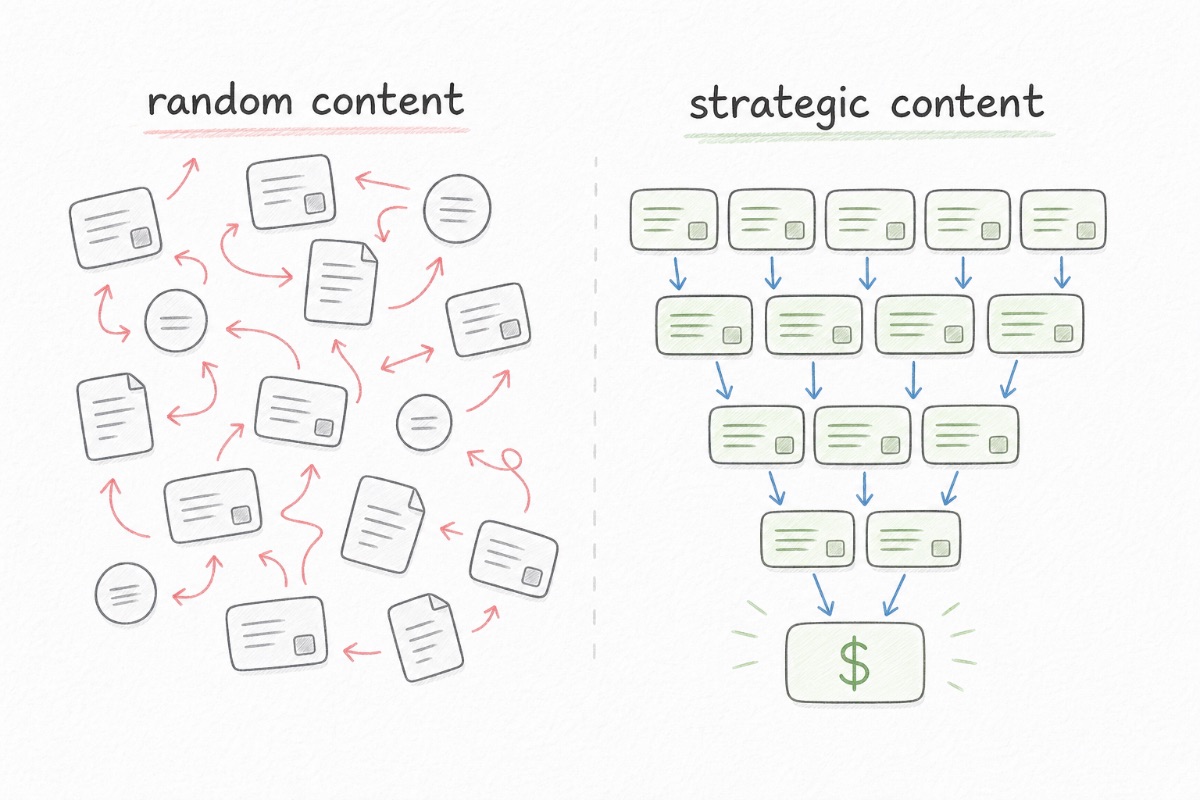
The problem is probably not that you need to create more content.
Most small teams already publish plenty: blog posts, LinkedIn updates, a newsletter, product emails, maybe a podcast that started with good intentions. The trouble is that almost none of it compounds. Each piece takes effort, earns a small burst of attention, then disappears, and the team starts over the next week.
Almost every durable result comes from a small set of habits, repeated long enough to build momentum. Everything else either supports those habits or quietly steals from them. For a small team, five of them carry the load.
The short version. If you do nothing else, do these five:
- Pick one primary channel.
- Write for one specific reader in one specific situation.
- Make the content unmistakably yours.
- Spend as much time distributing as creating.
- Keep improving the assets that already work.
If SEO is your channel and you want the fast route, the CopyJump agent handles the create-and-refresh half of this loop for you: planning, writing, and updating on-brand SEO content, so your energy goes to channel choice and distribution. If you would rather build the system yourself, here is how each piece works.
Why most small-team content never compounds
Content compounds when assets keep working after the week they were published. A search page brings qualified traffic every month. A newsletter list gets more valuable as it grows. A strong article earns links, sends readers to related pages, and makes the next piece easier to trust.
It stops compounding when every week is disconnected from the last. The difference usually looks like this:
| Activity that never compounds | Work that compounds |
|---|---|
| New posts published, old ones never touched | The best 10 to 15% refreshed like products |
| Effort split across three or four channels | One primary channel, worked deeply |
| A newsletter that starts, goes quiet, restarts | One reliable email cadence |
| Chasing the next format before the current one works | Momentum pushed in a single direction |
| Measuring views and likes | Measuring signups, pipeline, and list growth |
The left column is activity without infrastructure. That is usually an allocation problem rather than a writing problem: too many channels, too many formats, and not enough momentum in any one direction for anything to stick. The fix is less glamorous than most content advice. Do fewer things, in a better order, for longer.
1. Pick one primary channel
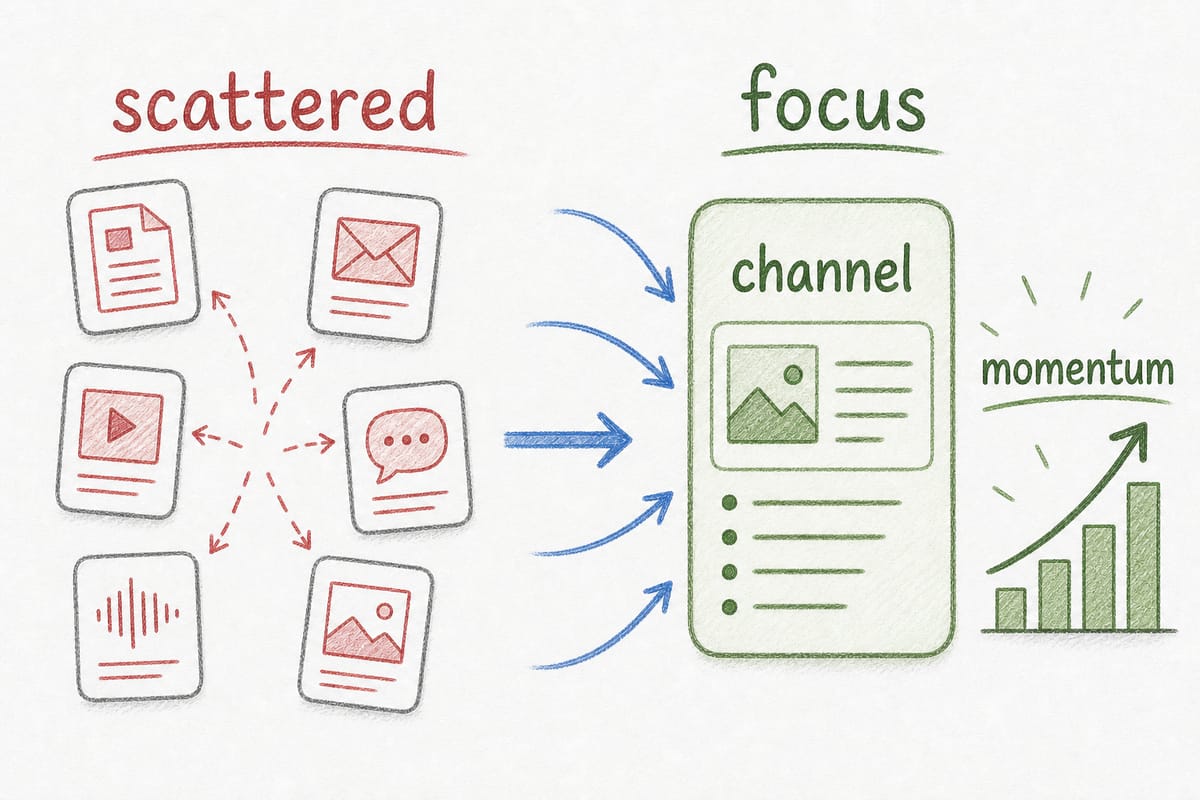
The most important content decision is where you concentrate. One channel, worked properly, beats "mostly one, but we should also post everywhere."
Every channel looks easy before you commit. SEO looks like writing. LinkedIn looks like posting. YouTube looks like recording. Email looks like sending a note once a week. Then you do the work and find each one has its own rhythm, quality bar, distribution mechanics, and feedback loop. Split your effort too early and you learn none of them deeply enough to win.
Start where your best buyers already go to learn about the problem you solve.
| Your audience | Primary channel to consider |
|---|---|
| B2B buyers researching before a purchase | Organic search and SEO content |
| Professionals following applied expertise | Email or LinkedIn |
| Consumers discovering visual products | One social platform they already use |
| People learning a hands-on skill | YouTube, search, or a practical email course |
| Existing customers who need education | Email, help content, and product-led guides |
Treat that as a starting point, not a law. The better evidence is your own customers: ask them where they learned about the problem, what they read before buying, and what they ignored. Once you pick, put 80% of your content energy there. The other 20% repurposes that work into secondary formats.
If SEO is your channel, build around a clear content strategy, topic clusters, and internal links. If email is your channel, build the habit and the list before you worry about fancy automation.
2. Write for one reader in one situation
Broad content is almost always weak content. "Content marketing tips" is a topic, not a reader.
"A solo marketer at a 15-person SaaS company who was told to do content, has no writer, no SEO background, and three other jobs" is a reader in a situation. The broad version explains content marketing. The specific version helps someone decide what to do next Tuesday.
Before you write or rewrite a page, answer four questions:
- Who has this problem?
- What happened that made them look for help today?
- What have they probably already tried?
- What would count as a genuinely useful answer for them?
If you cannot answer those, you are writing for a vague audience that "might be interested," which is how content turns into filler. Specificity also makes SEO easier, because search intent is rarely just a keyword. It is a person solving a problem with a level of urgency, knowledge, and buying readiness. Our search intent guide goes deeper, but match the situation, not just the phrase.
3. Make it unmistakably yours
The internet does not need another summary of the ten tips everyone already knows. Content gets remembered when it could only have come from your team. That does not mean every post needs a founder story. It means the page needs something a competitor cannot copy without copying you. That usually comes from four places.
Your experience. What have you actually done, what worked, what failed, what would you do differently? A specific mistake is more useful than a clean list of best practices.
Your point of view. Most content tries to offend no one, then wonders why no one remembers it. Take a position. If you believe small teams should skip multi-channel publishing until one channel works, say so.
Your data. Customer conversations, product usage, support tickets, sales objections, and internal experiments all give you information generic competitors do not have.
Your voice. If the byline disappeared, would a reader still know it came from you? If not, the writing has drifted into safe, generic language.
This is also where AI-assisted content usually fails. The draft is coherent but has no lived experience, no opinion, no proof, and no voice. If that is what you are seeing, read why most AI content fails. Every important page needs at least one thing only your team could have written.
4. Distribute as hard as you create
Most teams treat publishing as the finish line. It is the midpoint. A strong article seen by 200 people loses to a decent article seen by 10,000 of the right people. Distribution is how useful work reaches the people who need it.
After publishing something strong:
- Email it to your list.
- Post it on your primary channel.
- Turn one section into a shorter post, thread, or email.
- Add internal links from relevant existing pages.
- Share it in one or two communities where the topic genuinely fits.
- Send it directly to people who asked related questions.
- Credit anyone whose work or idea you referenced.
Do not turn this into link dumping. Would this be useful in the place you are sharing it? If yes, share it properly. If not, leave it. For every hour you spend creating, plan 30 to 45 minutes of distribution, and put that time on the calendar before you publish.
5. Treat your best posts like products
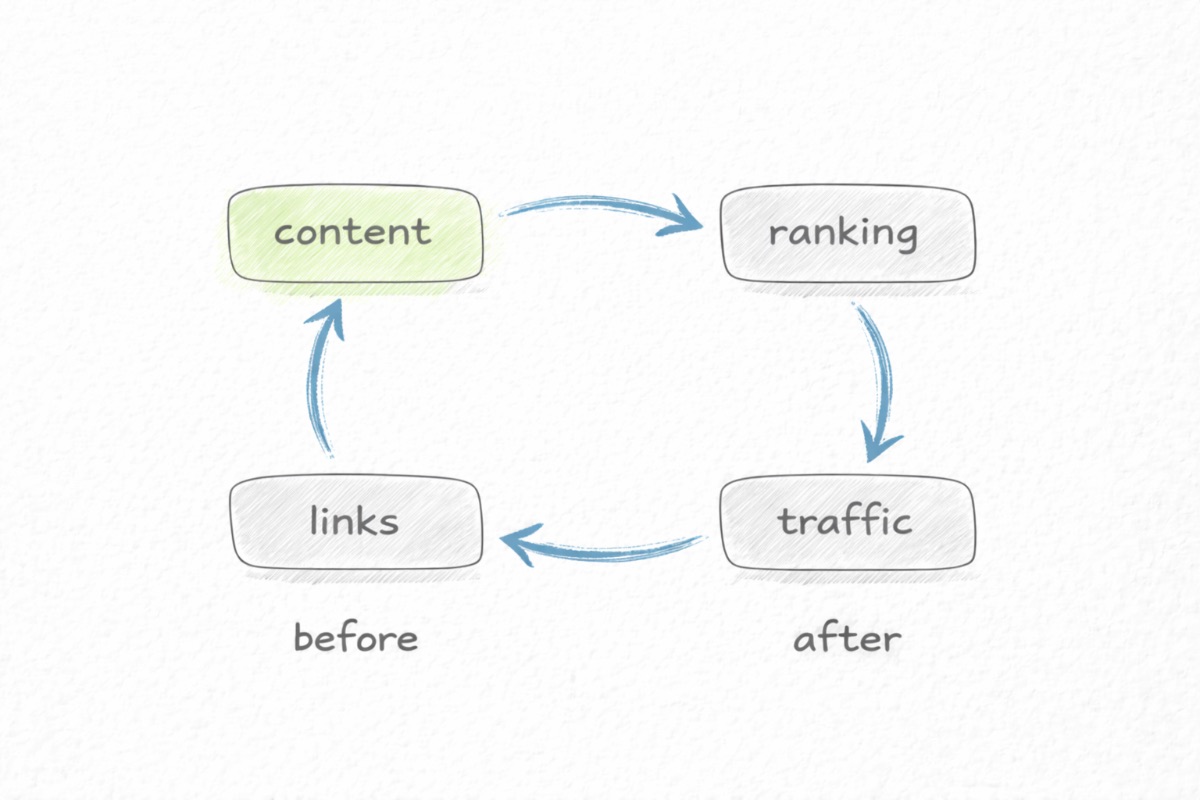
Most blogs run on one loop: publish, share once, forget, repeat. That builds a graveyard of old URLs. Some ranked for a while. Some almost worked. Some still pull traffic but drop readers into outdated examples, weak CTAs, and broken links.
Treat your strongest 10 to 15% of posts like products and keep improving them. Every quarter, review the pages that already have traction and ask:
- Are rankings slipping?
- Does the introduction still match search intent?
- Are the examples current?
- Are the statistics stale?
- Are there newer posts that should link to this page?
- Is there a clear next step?
- Are readers bouncing because the page answers too slowly?
This works because old pages already have advantages new ones lack: history, links, impressions, and some trust. Improving an asset with momentum is usually more efficient than starting from zero.
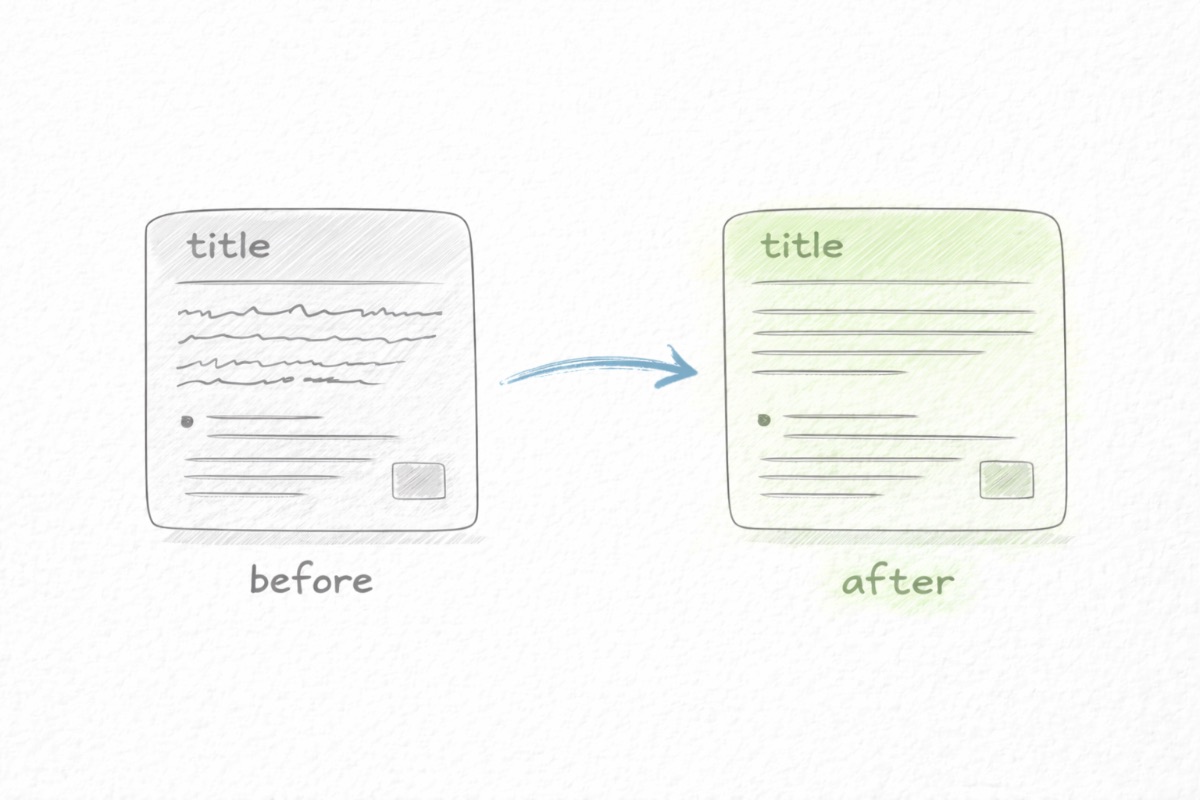
I worked with one team that spent a quarter publishing almost nothing new. Instead they rebuilt their 15 strongest posts: clearer introductions, current examples, better formatting, stronger internal links, more relevant CTAs. Their organic traffic rose about 40% over that quarter without a single new post. That result is hard to get by simply adding pages.
When you rewrite old content, work through it in order. Confirm the page's mission, fix the opening, rebuild the section flow, add depth only where it helps, then run a writing pass. Our five-pass editing framework is a useful structure for that work.
Build your email list before you need it
Email deserves its own attention, because it is the one asset most small teams regret delaying. Organic social reach shifts. Search results change. AI answers can cut clicks on some informational searches. Your email list is not immune to everything, but it is more owned than most rented channels.
The mistake is waiting until you need reach before building the list. By then, there is no meaningful list to use. A simple system is enough:
- Create one real reason to subscribe: a checklist, template, short course, or practical resource.
- Put signup forms on relevant high-traffic pages.
- Send one useful email on a reliable schedule.
- Write to one person, not an abstract audience.
An engaged list of 800 people who open, click, reply, and buy beats 10,000 followers who barely see your posts. Build it while you build the rest of the system, not after.
What to skip until the foundation works
Some content advice is correct in the abstract and wrong for your current stage. With a small team, hold off on these until the basics are working.
Video and podcasting. They can work, but production cost is high. Add them once your primary written or search channel has momentum.
Multi-channel publishing. Cross-posting everywhere feels efficient. Early on, it spreads attention thin without building depth anywhere.
Complex content operations. Briefs with 20 fields, sprawling calendars, and elaborate approval flows are built for bigger teams. Keep the system simple until simple breaks.
Technical SEO obsession. Meta descriptions, schema, and page speed matter, but they rarely save weak content. Get the fundamentals right first with on-page SEO, internal linking, useful structure, and search intent.
Trending format advice. Interactive content, voice search, AI summary optimization, and whatever else is hot this quarter can wait. Trends multiply a working system. They do not replace one.
None of this is bad forever. It is just the wrong sequence when the basics are not working yet.
A realistic weekly schedule
A practical 80/20 week for a small team.
Monday, review and choose. Spend 60 to 90 minutes on what happened last week: qualified traffic, signups, replies, demos, pipeline influence. Pick one page to write, update, or distribute.
Tuesday or Wednesday, create. One focused block to write or update. If you use AI, use it for outlines, first drafts, section rewrites, and research. Do not outsource judgment, examples, claims, or final voice.
Thursday, distribute. Email the piece, post it on your primary channel, add internal links from related pages, repurpose one useful section.
Friday, maintain. Improve one older page: add a link, sharpen an intro, update a stale example, tighten a section that reads generic.
Total: five to eight hours a week. That consistently beats 15 scattered hours across five channels.
The three metrics that actually matter
Most dashboards track too much. Page views, impressions, and likes feel useful, but they are context, not the decision signal. Track three things first.
Email list growth. A growing list shows content is reaching the right people and converting some into an owned audience. If traffic grows but the list does not, the page may be attracting the wrong intent or giving readers no reason to stay connected.
Qualified traffic. Raw traffic is not enough. Check time on page, scroll depth, pages per session, and the queries bringing people in. High traffic with poor engagement usually means the page is mismatched, too slow to answer, or too broad.
Pipeline influence. Harder to track, and the most important. Ask new customers what they read before reaching out. Use CRM source fields. Track demos, signups, trials, and sales that touch content. Even rough attribution beats guessing.
Everything else is secondary. Domain authority, impressions, shares, and follower counts can explain what is happening, but they should not drive the strategy on their own.
Common questions
How long before content marketing produces results?
For SEO content, expect three to six months before early posts rank, and nine to twelve before enough rank to see compounding traffic. Email can produce results sooner if you already have a list. Social usually needs three to six months of consistent posting before the signal is clear.
Is it worth hiring a writer for a small team?
Yes, if the bottleneck is writing time. No, if the bottleneck is strategy, positioning, distribution, or knowing what to say. Solve the direction first, then a writer helps you produce more of the right work.
What if my audience does not read blogs?
Then do not start with a blog. The channel follows the audience. If your buyers learn on LinkedIn, start there. If they search Google before buying, build search content. If they watch tutorials, consider video. The 80/20 still applies: pick one channel, get specific, distribute consistently.
How do I know if I picked the right channel?
Give it six months of real consistency, then look for early signals: engagement from the right people, subscriber growth, qualified traffic, replies, demos, or customers mentioning the content. If none of that appears, either the channel is wrong, the content is too broad, or the offer is not clear enough.
Can I do this with only one hour a week?
With one hour, focus on email or refreshing one high-value page. Blogging and SEO need sustained work to compound. A weekly email to an existing audience keeps the relationship alive while you build more capacity.
Where to start this week
Pick your one channel, define the reader, and put the next refresh on Friday's calendar. The five habits only work because you repeat them, and the repetition is the part most teams skip.
If you want the create-and-refresh half handled for you, that is exactly what CopyJump does for small teams: plan, write, refresh, and internally link on-brand SEO content without building a content department. See how the SEO Agent works, or check pricing.