

A content agent that researches before it writes
CopyJump studies your brand, your site, your audience, and real search demand before turning a Content Task into a review-ready draft you control.
If your first draft is not better-written and more accurate than ChatGPT or Claude, we refund you.
See the workflow behind every agent draft.
Content Tasks give every idea a brief, target, schedule, draft handoff, and review path before it becomes published content.
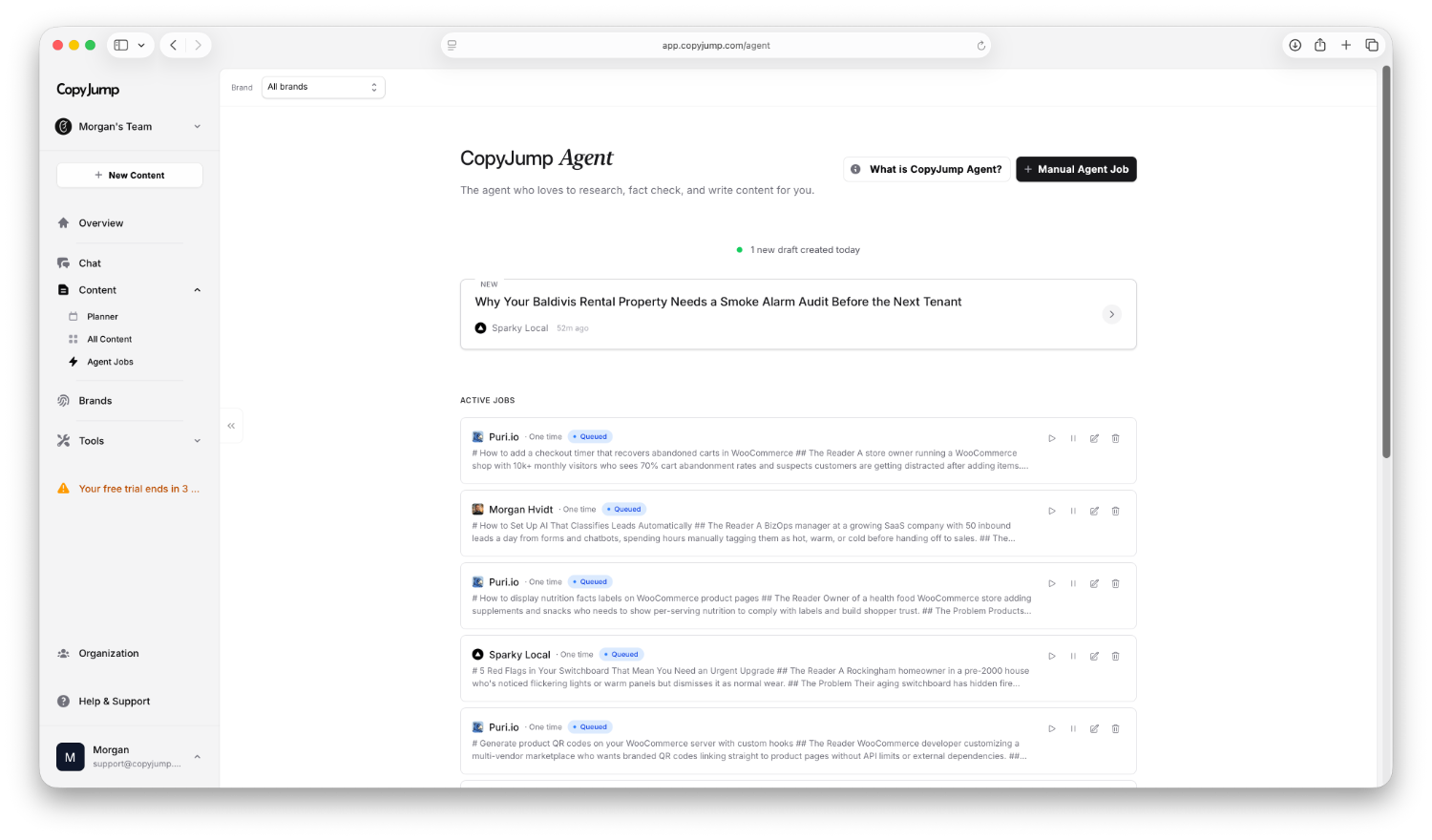
For teams that need content to run like a system.
The agent is useful when the problem is not just writing. It is knowing what to write, keeping it on-brand, reviewing it properly, and publishing consistently.
Solo founders
Publish every week without becoming an SEO specialist, hiring a content team, or rewriting generic AI drafts from scratch.
Small teams
Run ideas, tasks, schedules, drafts, and review through one visible workflow instead of scattered docs and prompts.
Agencies
Produce client-ready content across multiple brands without voice bleed, repeated context setup, or weak proof of process.
A repeatable SEO content workflow.
Solo founders, small teams, and agencies do not need another blank chat box. They need a system that turns brand context and SEO opportunity into content they can defend.
Generic AI
- Starts from a prompt
- Forgets your site
- Leaves research to you
- Creates rewrite risk
CopyJump Agent
- Starts from brand truth
- Uses site and keyword context
- Structures the brief
- Drafts, checks, and hands off
From idea to review-ready draft.
CopyJump keeps the workflow simple: load the right context, choose the work, let the agent prepare the draft, then review before anything goes live.
Add brand and site context
CopyJump learns your voice, products, audience, internal docs, website pages, and sitemap before the agent writes.
Choose or schedule a Content Task
Start from a suggestion, keyword opportunity, rough idea, or polished brief, then run now or schedule it for later.
Research, structure, and draft
The agent gathers evidence, checks search intent, plans the structure, and prepares a brand-aware draft.
QA, edit, approve, and publish
Drafts land in the editor for claims checks, editorial review, revisions, sharing, and final human approval.
Leverage with guardrails.
The point is not careless automation. CopyJump handles the heavy research and drafting work while keeping review, claims checks, edits, and publishing decisions in your hands.
The four jobs your content agent should handle.
CopyJump connects content ideas, research, drafting, and claims review so the agent produces useful work, not just more words.
Content ideas with real demand
The agent finds content ideas from your brand, website, audience, and keyword volume so you are not guessing what to write next.
- Finds topics people search for
- Connects ideas to your audience
- Turns opportunities into Content Tasks
Deep research and context
Before writing, the agent gathers the right internal and external context: brand profile, customers, company facts, sources, and internal link targets.
- Grounds itself in your brand profile
- Uses internal and external sources
- Finds useful internal links
Well-written first drafts
The agent turns the research into a clean, easy-to-read draft for your audience, with your products or services included where they naturally help.
- Writes for readers, not filler
- Keeps the offer connected
- Gives you a strong draft to edit
Fact-checking and claims
Claims, numbers, references, and product mentions are checked against available sources so unsupported details are softened or flagged for review.
- Reduces hallucinated details
- Checks claims against sources
- Highlights what needs human review
Keyword data connected to production.
Keyword research is more useful when it feeds the brief, task, internal links, and final draft. CopyJump keeps SEO context connected to the content workflow.
Real search demand
Use keyword volume and opportunity data before committing time, budget, or agent runs to a topic.
Search intent in the brief
The agent uses the search intent and content type to shape the structure, not just sprinkle keywords into copy.
Site-aware internal links
Indexed website pages help the draft fit your existing site structure instead of floating away from the rest of your content.
Show Up Where Your Buyers Are Searching
Start with the phrases buyers already use, then turn the strongest opportunities into briefs and Content Tasks.
Use CopyJump with your preferred tools.
Start in the CopyJump UI, or connect the agent to your CMS, dashboards, AI assistants, and publishing stack with REST and MCP support.
Frequently Asked Questions
How is this different from ChatGPT or Claude?▼
ChatGPT and Claude are models. CopyJump is a content workflow around the model: brand onboarding, site indexing, keyword context, Content Tasks, scheduling, internal links, Editorial QA, Claims QA, editor handoff, and review control. The output is different because the inputs and workflow are different.
Do I still control what gets published?▼
Yes. The agent prepares drafts for review. You can edit, revise with AI assistance, run checks, share for approval, and decide what actually gets published. The goal is leverage with guardrails, not hands-off publishing.
Will AI content hurt my brand or SEO?▼
Low-quality AI content is risky when it is generic, thin, unsupported, or disconnected from search intent. CopyJump is built to avoid that failure mode by grounding drafts in brand context, site context, keyword intent, evidence, internal links, and review checks before you publish.
What does the agent actually check?▼
The workflow checks whether the draft follows the brief, reflects brand context, fits the content type, uses relevant SEO context, and avoids unsupported claims where the available truth sources are not strong enough. You still make the final judgment before publishing.
Is this for founders, teams, or agencies?▼
All three. Founders use it to publish consistently without hiring a content team. Small teams use it to keep ideas, schedules, drafts, and review in one workflow. Agencies use it to manage multiple brands without context bleed or weak proof of process.
How does scheduling work?▼
You can run the agent immediately or schedule a Content Task for later. The task keeps the brief, brand, content type, and instructions attached so scheduled production stays connected to the original plan.
What types of content can it create?▼
The strongest fits are SEO articles, tutorials, how-to guides, comparison pages, landing pages, content refreshes, case studies, and industry commentary. The agent adapts the workflow to the content type instead of treating every request like a generic blog post.
Does CopyJump guarantee rankings?▼
No. Rankings depend on competition, authority, search intent, content quality, and time. CopyJump helps you produce better-structured, brand-aware, evidence-backed content, but it does not promise that every page will rank.
Try one researched, brand-aware draft.
Compare CopyJump against your usual ChatGPT or Claude workflow. Start a 3-day free trial, then continue at $99/month.
3-day free trial - 30 articles included - refund if your first draft is not better-written and more accurate than generic AI