

Lesson 10: The 5-Pass Editing Framework
Intent, specificity, structure, voice, linking. The workflow that turns generic AI output into content worth ranking.

This is the most important lesson in the course. Everything else (keywords, strategy, AI drafts) leads here. The 5-pass editing framework is what separates content that ranks from content that disappears.
Five passes sounds like a lot of editing. It's not. Each pass has a specific focus, takes five to fifteen minutes, and catches different problems. Together, they transform generic drafts into content that deserves to rank.
Pass 1: Intent Match
This builds directly on Lesson 6: Search Intent. Open your target SERP. Look at the top three results. Now look at your draft.
Does your content deliver what searchers are looking for? If the top results are all step-by-step guides and your draft is a conceptual essay, you have an intent mismatch. If the top results answer the question in the first paragraph and your draft buries the answer in section three, you have a problem.
The intent pass isn't about optimization. It's about fundamentals. Is this the right type of content for this query?
Check these things:
Does your intro answer or directly address the query? Searchers should know they're in the right place within seconds.
Does your structure match what's working? If successful content uses H2s for major steps, yours probably should too. If successful content is comparison tables, an essay won't work.
Does your depth match? Some queries want comprehensive guides. Some want quick answers. Match the expectation.
If you have major intent problems, fix them before moving on. No amount of polish helps if the foundation is wrong.
Pass 2: Specificity
This pass separates your content from everyone else's. AI generates generic advice. That's why most AI content fails. This pass makes it yours.
Go through every section and ask: where can I add something specific? Real examples, actual numbers, concrete details, specific situations.
Generic: "Many businesses see improved results with this approach."
Specific: "When we tested this with a 12-person marketing team, they reduced content production time from eight hours to three per post."
Generic: "There are several tools you can use for this."
Specific: "We use [Tool X] for initial research and [Tool Y] for tracking. Together they cost about $100/month and save us roughly four hours per week."
Generic: "This is a common mistake."
Specific: "Last quarter, we audited 47 client sites and found 34 of them making this exact mistake."
The specificity pass is where you add what AI can't generate: your experience, your data, your examples. Every section should have at least one specific detail that proves you actually know what you're talking about.
If you don't have specific examples for a section, ask yourself why you're writing about it. Generic advice on topics you don't know well is just noise.
Pass 3: Structure
Now that intent and specificity are handled, make the content easy to consume.
Scan just the headings. Do they tell the story of the post? Someone should be able to read only your H2s and understand what the content covers and in what order.
Check paragraph length. Long paragraphs are walls of text that people skip. Break them up. Two to four sentences per paragraph is usually right. Single-sentence paragraphs work for emphasis.
Add scannable elements where they help. Not every post needs bullet points and tables. But when you're listing steps, options, or criteria, formatting them clearly helps readers who are skimming. Just don't overdo it. A post that's all bullets feels like a slide deck, not an article.
Check flow between sections. Each section should connect to the next. Transitions don't need to be explicit, but the reader should understand why you're moving from one topic to another.
Check the intro and conclusion. Does the intro hook readers and tell them what they'll get? Does the conclusion give them a clear next step? These are the most-read parts of any post. Make them count.
Pass 4: Voice
This is where you kill the AI tone and make the content sound like you.
Read the post out loud. Every sentence that sounds like a press release or a corporate memo needs rewriting. If you wouldn't say it in conversation, don't write it. If you have brand voice guidelines defined, now is when you check against them.
Eliminate hedge words. "May help," "can potentially," "might improve." Either say it confidently or cut it. Hedging makes you sound unsure of your own content.
Cut the formal transitions. "Furthermore," "moreover," "additionally." These are filler. Start the sentence without them. The meaning is clearer.
Remove the obvious statements. "It's important to note that content quality matters." Of course it does. Say something non-obvious or say nothing.
Add personality where appropriate. An opinion, a bit of frustration with common mistakes, enthusiasm for something that works well. Content with personality is content readers remember.
Check for consistency. Does the voice stay consistent throughout, or does section three suddenly sound more formal than section one? AI sometimes shifts tone between generations. Smooth it out.
The goal isn't to impose an artificial voice. It's to remove the artificial distance that AI creates. Write like you're explaining this to a smart colleague, not presenting to a boardroom.
Pass 5: Linking
The final pass connects your content to your site and to the reader's next action.
Add internal links. Every post should link to your pillar page and to two or three related posts. These links help Google understand your site structure and help readers explore more of your content. Lesson 12 covers internal linking strategy in depth.
Check that links are contextual. Links should appear where they're relevant, not dumped at the end in a "related posts" list. "For more on keyword research, see our keyword research guide" in the middle of a relevant paragraph is better than a generic list at the bottom.
Add one clear call to action. What should the reader do next? Read another post? Try your tool? Sign up for something? Pick one and make it clear. Don't overwhelm with options.
Check external links if you have them. Are they going to authoritative sources? Do they open in new tabs? Are they still working? Broken or sketchy links hurt trust.
Review the navigation. Someone landing on this post from search should be able to easily find your other content. Links in the body help. Clear site navigation helps. Make it easy to explore.
Putting It Together
Each pass takes five to fifteen minutes. The whole framework adds about an hour of editing to whatever time you spent drafting.
That's not nothing. But it's the difference between content that disappears and content that ranks. This is where generic AI output becomes something worth reading. Something that's actually yours.
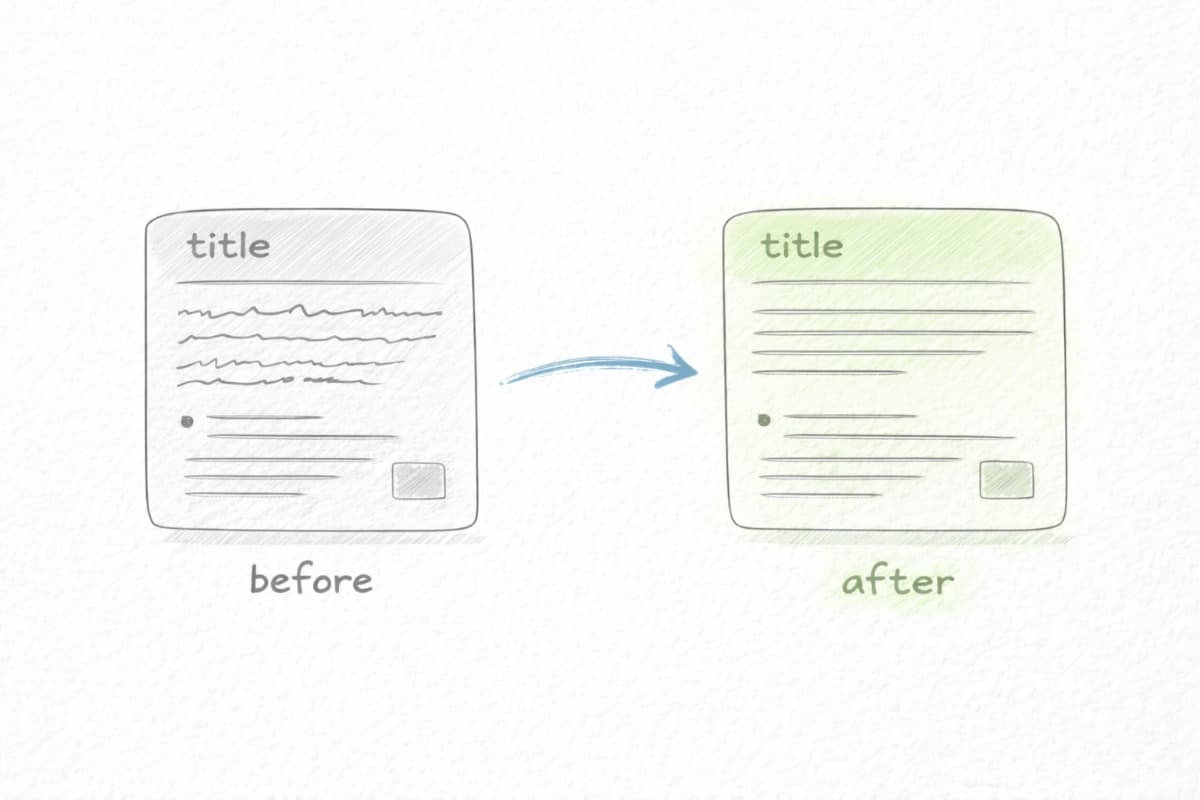
You don't have to do all five passes in one sitting. Do passes one and two right after drafting while the content is fresh. Let it sit. Come back for passes three through five with fresh eyes.
Over time, the passes get faster. You start writing with intent match in mind. You automatically add specifics during drafting. You develop instincts for voice. The framework becomes habit.
Using CopyJump for Editing
The Content Agent doesn't just generate drafts. It already knows your brand. It pulls from your voice guidelines, target audiences, and existing content before writing anything. That means less editing on passes two and four because specificity and voice are built into the draft from the start.
Internal linking? The agent reads your sitemap and adds relevant links automatically. Pass five becomes a quick review instead of a research project.
You still do the five passes. But when the draft arrives already on-brand and linked, you're polishing instead of rebuilding.
Next: Lesson 11: On-Page SEO Fundamentals
Back to: Course Overview