

Lesson 8: Content Strategy for Small Teams
What to write first, what to skip. A realistic publishing plan when you don't have a content team.

Content strategy for a team of one or two is fundamentally different from content strategy for a team of ten. You can't publish five posts per week. You probably can't even publish one. So the question isn't "what should we write?" It's "given our limited capacity, what should we write first?"
This lesson is about making those choices.
The Capacity Reality Check
Before planning content, be honest about what you can sustain. Not what you can do in a burst of motivation, but what you can maintain month after month.
One quality post per week is ambitious for most small teams. Every two weeks is more realistic. Once a month is fine if that's what you can sustain with quality.
Whatever cadence you choose, protect it ruthlessly. Consistency builds authority. A predictable publishing schedule (even if slow) beats sporadic bursts followed by silence.
If you're unsure, start with once every two weeks. It's easier to increase cadence later than to burn out and stop entirely.
AI tools like CopyJump can significantly increase your output, but faster drafts don't mean less work. Every AI draft still needs your review, your expertise, and your final touch. Plan your capacity around the full process, not just the first draft.
Prioritizing What to Write
You have limited publishing slots. Not everything can go first. Here's how to prioritize.
The "funnel" is just a way to think about how close someone is to buying. People at the top are just learning. People at the bottom are ready to decide.
| Funnel stage | What they're doing | Example search |
|---|---|---|
| Top | Learning about the problem | "what is content marketing" |
| Middle | Exploring solutions | "how to write blog posts faster" |
| Bottom | Ready to decide | "best AI writing tools for marketing teams" |
Write bottom-of-funnel content first. These are posts that directly relate to your product or service. Comparison posts, alternative posts, "how to do X" posts where X is what your product does. The traffic might be lower, but the visitors are closer to buying.
A post targeting "best AI writing tools for marketing teams" brings in people actively looking for what you sell. A post targeting "what is content marketing" brings in people who might need you eventually, but not today.
Start with the posts that can drive revenue, then expand to awareness content once you have capacity.
Write your pillar early. The pillar page gives you something to link to from every supporting post. It establishes your topic cluster and starts building authority. Get it published early even if it's not perfect. You can improve it over time.
Write for gaps, not glory. Big obvious keywords have big obvious competition. Look for the specific, long-tail keywords where current content is weak. A post that ranks #1 for a 500-volume keyword is worth more than a post that ranks #47 for a 50,000-volume keyword.
Write about your differentiators. What makes you different from competitors? That's your easiest content win. You know it better than anyone, competition is lower because it's your unique angle, and it attracts exactly the people who'd benefit from your approach. If your product handles something differently, write about why that approach matters.
Write what you can actually write well. Topics where you have genuine expertise will be easier to write and more valuable when published. Don't stretch into areas where you're clearly out of your depth just because the keyword looks good.
The Minimum Viable Content Plan
For most small teams, start with this:
One pillar page on your core topic. This is your foundation. Make it comprehensive enough to rank and useful enough to impress visitors.
Three to five supporting posts that cover the most important related topics. Prioritize posts that are close to buying intent or that fill obvious gaps in competitor coverage.
That's five to six posts total. If you're publishing every two weeks, that's three months of content. Not overwhelming. Achievable.
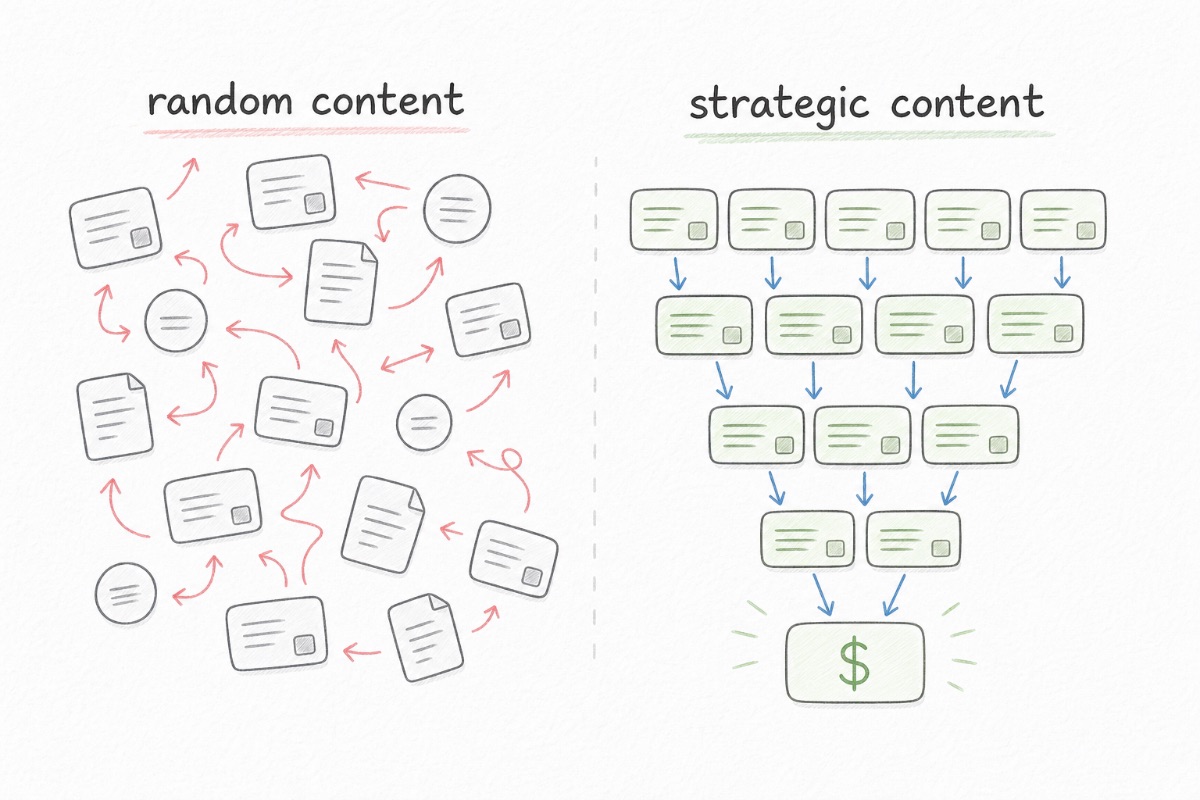
Once that cluster is established and you see what's resonating, plan the next five to six posts.
What to Skip (At Least for Now)
Some content isn't worth your limited capacity.
Skip content that's purely informational with no connection to your business. "The history of marketing" might be interesting, but if it doesn't connect to what you sell, it's not driving revenue.
Skip content where you have no differentiation angle. If you can only say what everyone else says, you won't rank, and even if you did, there's no reason for readers to remember you.
Skip content that requires more depth than you can provide. Some topics require original research, extensive case studies, or expert interviews. If you can't do that work, pick a different topic where your existing knowledge is enough.
Skip chasing trending topics unless they're directly relevant. Writing about whatever's hot this week feels productive but rarely builds lasting value. Stick to your cluster.
Planning in Quarters
Small teams do well with quarterly planning. Each quarter, identify:
What posts will you publish? Be specific. Titles, keywords, intent.
What existing posts need updating? Check your rankings and refresh content that's slipping. Lesson 14 covers how to identify when content needs attention.
What's your publishing cadence? How many new posts, how many updates?
What's the goal for this quarter? More traffic, better rankings for specific keywords, conversion improvements?
Quarterly planning keeps you focused without being so long-term that plans become irrelevant. Twelve weeks is enough to see results and adjust.
The One-Person Content System
If you're doing this alone, you need a system that doesn't require heroic effort.
Batch your research. Once per month, do all your keyword research and SERP analysis for the next four to six posts. Write briefs for each one. When it's time to write, you're not starting from scratch.
Batch your writing. If possible, write in focused blocks rather than scattered time. Two three-hour sessions produce more than twelve thirty-minute sessions.
Batch your editing. Let drafts sit before editing. Fresh eyes catch more. If you write Monday and edit Thursday, you'll produce better work than writing and editing in one session.
Use AI where it helps. AI can generate first drafts, create outlines, suggest headlines. It can't replace your expertise and judgment, but it can speed up the mechanical parts. Lesson 9 covers how to use AI effectively, and the Content Agent is built specifically for this workflow.
Schedule in advance. Write posts ahead of schedule so you're not publishing at the last minute. A content calendar helps you see what's coming and maintain a buffer. Having a buffer lets you maintain consistency even when life gets busy.
The Small Team Advantage
Big companies have more resources. They can publish more content, hire more writers, invest in more tools. But they also move slowly, need approvals, and default to safe, generic content.
You can be faster. You can have opinions. You can publish something that takes a stance without running it through five stakeholders. You can respond to what's happening in your industry this week, not last quarter.
Use that advantage. Create content with personality and point of view. Go specific where they go generic. Be useful where they're just comprehensive.
You won't outproduce them. You can out-think them.
Next: Lesson 9: AI as Draft Engine
Back to: Course Overview
Want this handled for you? The CopyJump SEO Agent applies these lessons automatically — research, briefs, internal links, and brand-aware drafts.
Meet the SEO Agent